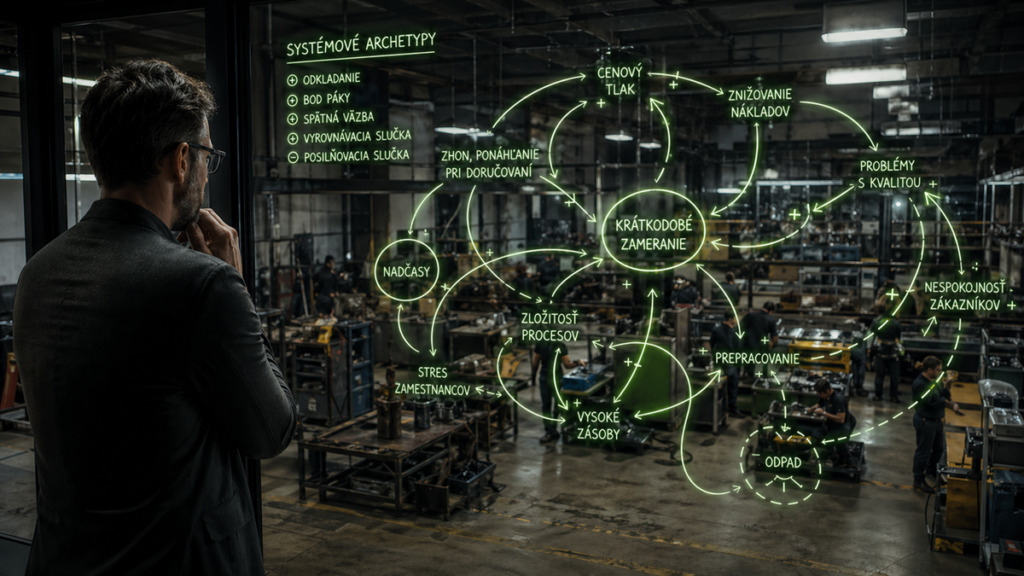
Have you ever solved a problem in one department, only to have another (and worse) one immediately appear in another? Welcome to the world of system archetypes—repeated patterns that define the dynamics of any organization.
- Archetype: “Shifting the Burden”
This pattern is most common in Lean environments. Instead of looking for the root cause, we apply a quick fix.
Manifestation: The operator has a problem with a machine, we give them a makeshift guide on how to “work around” it.
System Consequence: The symptom goes away, but the underlying problem festeres. Over time, the system’s ability to solve the real cause atrophies.
Solution: Always separate the short-term fix from the long-term system solution.
- Archetype: “Limits to Growth”
A successful Lean transformation often hits an invisible wall.
Manifestation: You implement 5S and standardization, efficiency skyrockets, but then it stalls and starts to decline.
Why: We forgot Sociology. People feel overwhelmed or under pressure from “constant pressure” and the system hits its human limits.
Solution: Anticipate limiting factors before they become a drag.
- How to use archetypes for Knowledge Management?
Archetypes are “knowledge templates”. If your people know them, they will stop blaming each other (Sociology) and start blaming the structure of the system.
Practice: Create a library of your own failure archetypes. When a mistake happens, ask: “Which archetype just happened here?”
Manifesto 2026: Changing Perspective
The modern manager doesn’t look for the culprit. The modern manager looks for the feedback loop that caused the error. Understanding archetypes allows you to not put out fires, but to build fireproof systems.